Metabolic health
AOD-9604
Approved registered clients only.
Data sheet
AOD-9604
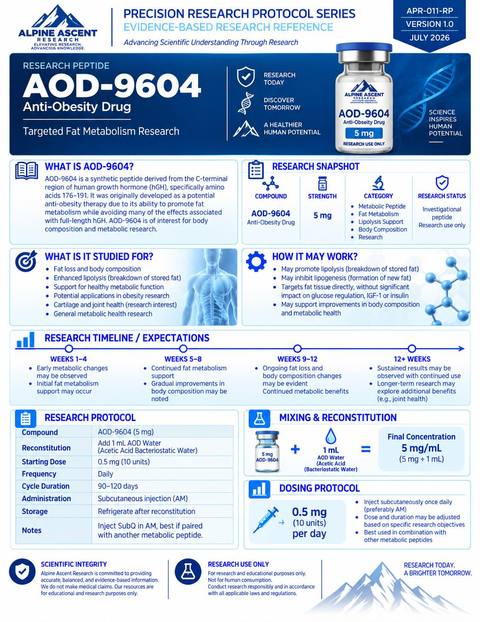
This preview is the one-page Alpine Ascent sheet for AOD-9604. It is the reference copy for reconstitution, frequency, and the figures printed on the sheet. Open it when you want the full page.
What it is
AOD-9604 is a synthetic peptide derived from the C-terminal region of human growth hormone, specifically amino acids 176–191. It was originally developed as a potential anti-obesity fragment because it may promote fat metabolism while avoiding many of the effects associated with full-length growth hormone. It is of interest for body composition and metabolic research.
What researchers study it for
- Fat loss and body composition
- Enhanced lipolysis, the breakdown of stored fat
- Support for healthy metabolic function
- Potential applications in obesity research
- Cartilage and joint health research
- General metabolic health research
How it may work
- May promote lipolysis, the breakdown of stored fat
- May inhibit lipogenesis, the formation of new fat
- Targets fat tissue directly, without a significant impact on glucose regulation, IGF-1, or insulin
- May support improvements in body composition and metabolic health
Research timeline
Weeks 1–4
Early metabolic changes may be observed. Initial fat-metabolism support may occur.
Weeks 5–8
Continued fat metabolism support. Gradual improvements in body composition may be noted.
Weeks 9–12
Ongoing fat loss and body-composition changes may be evident, along with continued metabolic observations.
12+ weeks
Sustained results may be observed with continued use. Longer-term research may explore additional endpoints, such as joint health.
5 mg research protocol
- Reconstitution
- 1 mL acetic acid or bacteriostatic water
- Final concentration
- 5 mg/mL
- Starting dose
- 0.5 mg (10 units)
- Frequency
- Daily
- Cycle duration
- 90–120 days
- Administration
- Subcutaneous injection in the morning
- Storage
- Refrigerate after reconstitution
- Notes
- The sheet notes morning subcutaneous injection, and that it is best studied if paired with another metabolic peptide.
Research duration on the sheet: 90–120 days on the source sheet.
Reconstitution
- 5 mg + 1 mL acetic acid or bacteriostatic water = 5 mg/mL.
- 10 units = 0.5 mg.
Titration notes
- The sheet lists 0.5 mg (10 units) once daily.
- Dose and duration may be adjusted based on the specific research objective.
Important considerations
- For research and educational purposes only.
- Not for human consumption.
- Conduct research in accordance with applicable laws and regulations.
Evidence summary
- Research status on the sheet
- Investigational peptide, research use only
References
Completed published studies are listed below and labeled as in vitro, animal, or human research. Favorable and unfavorable results are both included, including cancer studies. This is not every paper on the compound, and it is not a recommendation or a dose.
The weight-loss signal is from mice. A later, larger human obesity program did not confirm a clear weight-loss benefit, and that larger trial was not published as a primary paper. The breast-cancer experiment used growth-hormone fragment 176–191, the sequence AOD-9604 is modified from, not AOD-9604 itself.
- AOD9604 increased fat oxidation and weight loss in obese miceAnimal
Obese mice. Chronic treatment with this growth-hormone fragment increased fat oxidation and reduced weight.
- AOD9604 and lipid metabolism in obese mice and beta-3 receptor knockout miceAnimal
Obese mice lost weight and body fat over 14 days. The same weight change did not occur in mice lacking the beta-3 adrenergic receptor.
- Growth-hormone fragment 176–191 with doxorubicin in breast cancer cellsIn vitro
MCF-7 breast cancer cells. The unmodified fragment, loaded with doxorubicin into nanoparticles, made the drug slightly more toxic to the cells. The peptide by itself did not kill them.
Available strength
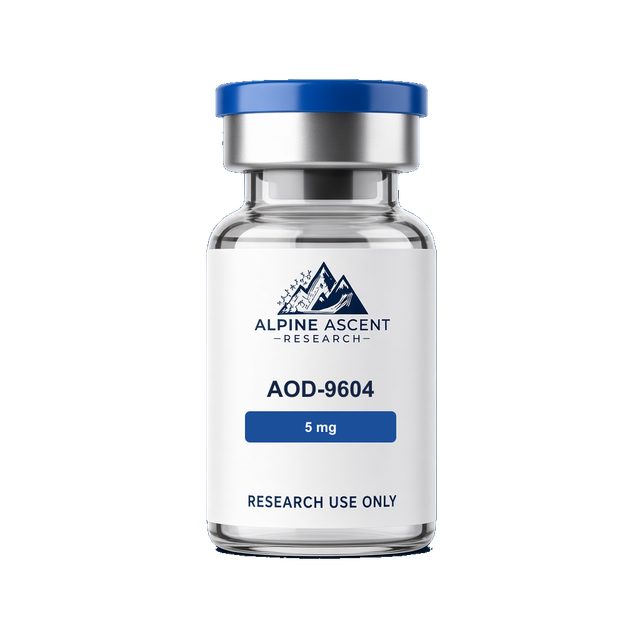
5 mg vial. Format: Lyophilized powder.
For educational and research purposes only. These materials are not approved to diagnose, treat, cure, or prevent any disease. Nothing on this page is a dose recommendation or medical advice. The Alpine Ascent data sheet is the reference copy for each compound.