Skin & tissue
GHK-Cu
Approved registered clients only.
Data sheet
GHK-Cu
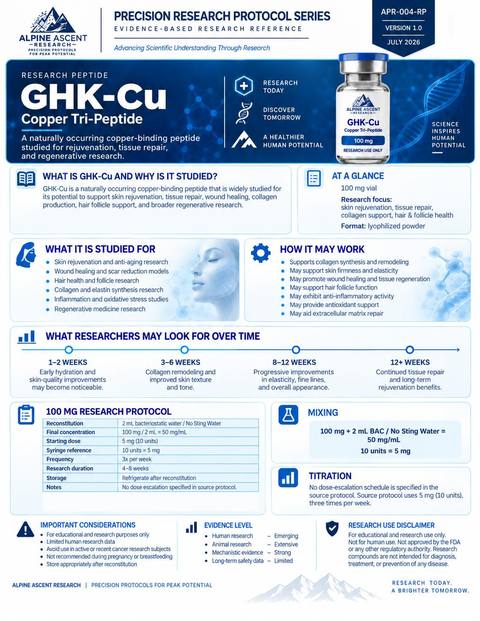
This preview is the one-page Alpine Ascent sheet for GHK-Cu. It is the reference copy for reconstitution, frequency, and the figures printed on the sheet. Open it when you want the full page.
What it is
GHK-Cu is a naturally occurring copper-binding peptide studied for rejuvenation, tissue repair, and regenerative research. It is widely studied for its potential to support skin rejuvenation, tissue repair, wound healing, collagen production, hair follicle support, and broader regenerative research.
What researchers study it for
- Skin rejuvenation and anti-aging research
- Wound healing and scar reduction models
- Hair health and follicle research
- Collagen and elastin synthesis research
- Inflammation and oxidative stress studies
- Regenerative medicine research
How it may work
- May support collagen synthesis and remodeling
- May support skin firmness and elasticity
- May promote wound healing and tissue regeneration
- May support hair follicle function
- May exhibit anti-inflammatory activity
- May provide antioxidant support
- May aid extracellular matrix repair
Research timeline
1–2 weeks
Early hydration and skin-quality improvements may become noticeable.
3–6 weeks
Collagen remodeling and improved skin texture and tone.
8–12 weeks
Progressive improvements in elasticity, fine lines, and overall appearance.
12+ weeks
Continued tissue repair and long-term rejuvenation benefits.
100 mg research protocol
- Reconstitution
- 2 mL bacteriostatic water or no-sting water
- Final concentration
- 50 mg/mL
- Starting dose
- 5 mg (10 units)
- Syringe reference
- 10 units = 5 mg
- Frequency
- 3 times per week
- Research duration
- 4–6 weeks
- Storage
- Refrigerate after reconstitution
Research duration on the sheet: 4–6 weeks on the source protocol.
Reconstitution
- 100 mg + 2 mL bacteriostatic or no-sting water = 50 mg/mL.
- 10 units = 5 mg.
Titration notes
- No dose-escalation schedule is specified on the source protocol.
- Source protocol uses 5 mg (10 units), three times per week.
Important considerations
- For educational and research purposes only.
- Limited human-research data.
- Avoid use in active or recent cancer research subjects.
- Not recommended during pregnancy or breastfeeding.
- Store appropriately after reconstitution.
Evidence summary
- Human research
- Emerging
- Animal research
- Extensive
- Mechanistic evidence
- Strong
- Long-term safety data
- Limited
References
Completed published studies are listed below and labeled as in vitro, animal, or human research. Favorable and unfavorable results are both included, including cancer studies. This is not every paper on the compound, and it is not a recommendation or a dose.
The cancer-related GHK papers are a gene-expression analysis and the authors' report of a mouse sarcoma experiment. They are not human cancer trials. The fibroblast study used repair cells, including cells taken after cancer radiation.
- Topical glycyl-L-histidyl-L-lysine copper for diabetic neuropathic ulcersHuman
People with diabetic plantar ulcers. A topical copper-peptide gel closed more of the ulcer than the gel without the peptide. This was a skin gel, not an injection.
- GHK-Cu and growth of normal and irradiated fibroblastsIn vitro
Human skin fibroblasts, including cells taken after radiation for head and neck cancer. GHK-Cu sped doubling and raised early growth-factor output. These were repair cells, not cancer cells.
- Topical GHK-Cu on irradiated rat woundsAnimal
Rats after radiation. A topical GHK-Cu gel did not reduce flap injury or increase blood vessels compared with ointment alone.
- GHK and cancer-related gene expressionIn vitro
A gene-expression database ranked GHK as reversing about 70% of a 54-gene pattern tied to aggressive colon cancer. The same paper reports that GHK-copper suppressed sarcoma 180 growth in mice. This is not a human cancer trial.
- GHK-Cu and gene expression in breast and prostate cancer cellsIn vitro
Stored profiles of MCF7 breast cancer cells and PC3 prostate cancer cells treated with GHK-Cu showed changes in cancer-related genes. The paper does not measure tumor size.
Available strength
100 mg vial. Format: Lyophilized powder.
For educational and research purposes only. These materials are not approved to diagnose, treat, cure, or prevent any disease. Nothing on this page is a dose recommendation or medical advice. The Alpine Ascent data sheet is the reference copy for each compound.