Hormonal
Kisspeptin
Approved registered clients only.
Data sheet
Kisspeptin
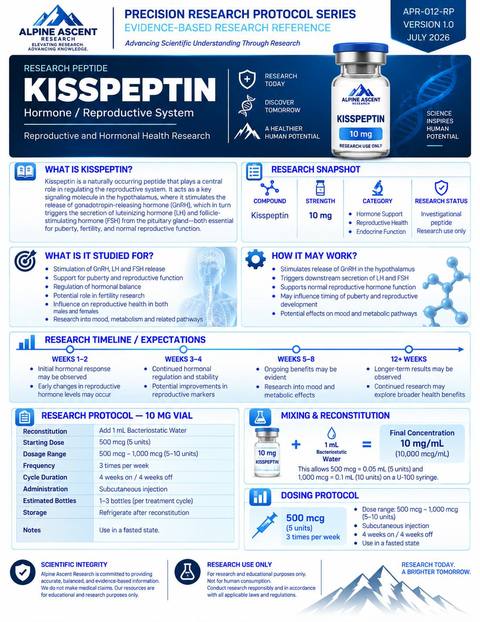
This preview is the one-page Alpine Ascent sheet for Kisspeptin. It is the reference copy for reconstitution, frequency, and the figures printed on the sheet. Open it when you want the full page.
What it is
Kisspeptin is a naturally occurring peptide that plays a central role in regulating the reproductive system. It acts as a key signaling molecule in the hypothalamus, where it stimulates the secretion of gonadotropin-releasing hormone (GnRH). GnRH then triggers secretion of luteinizing hormone (LH) and follicle-stimulating hormone (FSH) from the pituitary, both essential for puberty, fertility, and normal reproductive function.
What researchers study it for
- Stimulation of GnRH, LH, and FSH release
- Support for puberty and reproductive function
- Regulation of hormonal balance
- Potential role in fertility research
- Influence on reproductive health in both males and females
- Research into mood, metabolism, and related pathways
How it may work
- Stimulates release of GnRH in the hypothalamus
- Triggers downstream secretion of LH and FSH
- Supports normal reproductive hormone function
- May influence timing of puberty and reproductive development
- Potential effects on mood and metabolic pathways are also discussed on the sheet
Research timeline
Weeks 1–2
Initial hormonal response may be observed. Early changes in reproductive hormone levels may occur.
Weeks 3–4
Continued hormonal regulation and stability. Potential improvements in reproductive markers.
Weeks 5–8
Ongoing benefits may be evident. Research into mood and metabolic effects.
12+ weeks
Longer-term results may be observed. Continued research may explore broader health benefits.
10 mg research protocol
- Reconstitution
- 1 mL bacteriostatic water
- Final concentration
- 10 mg/mL (10,000 mcg/mL)
- Starting dose
- 500 mcg (5 units)
- Dosage range
- 500 mcg to 1,000 mcg (5–10 units)
- Frequency
- 3 times per week
- Cycle duration
- 4 weeks on, 4 weeks off
- Administration
- Subcutaneous injection, in a fasted state
- Storage
- Refrigerate after reconstitution
Research duration on the sheet: 4 weeks on and 4 weeks off on the source sheet.
Reconstitution
- 10 mg + 1 mL bacteriostatic water = 10 mg/mL.
- 5 units = 500 mcg. 10 units = 1,000 mcg.
Titration notes
- The sheet lists a range of 500–1,000 mcg rather than a weekly escalation.
- Starting example: 500 mcg (5 units), 3 times per week.
Important considerations
- For research and educational purposes only.
- Not for human consumption.
- Use in a fasted state, as noted on the sheet.
- Conduct research in accordance with applicable laws and regulations.
Evidence summary
- Research status on the sheet
- Investigational peptide, research use only
References
Completed published studies are listed below and labeled as in vitro, animal, or human research. Favorable and unfavorable results are both included, including cancer studies. This is not every paper on the compound, and it is not a recommendation or a dose.
Kisspeptin is the product of KISS1, first studied as a metastasis-suppressor gene. Some breast-cancer models later reported the opposite direction. The links below are the completed studies with a suppressor result.
- Kisspeptin-54 triggers egg maturation in women undergoing in vitro fertilizationHuman
Women in IVF treatment. A single kisspeptin-54 injection matured eggs, and embryos from those eggs led to pregnancies.
- Intranasal kisspeptin rapidly stimulates gonadotropin release in humansHuman
Healthy men and women, and women with hypothalamic amenorrhoea. Intranasal kisspeptin-54 raised luteinizing hormone compared with placebo.
- KiSS-1 peptide, metastin, and melanoma spreadIn vitro
The KiSS-1 peptide blocked invasion in cultured cells and reduced lung metastases of melanoma cells in mice. It did not stop the first tumor from forming.
- KiSS-1 and metastasis of MDA-MB-435 cellsAnimal
Mice. Cells carrying KiSS-1 still formed a tumor in the mammary fat pad, but metastatic spread fell by about 95% compared with control cells.
- Kiss-1 in colorectal cancer cells and tumor samplesIn vitro
Removing Kiss-1 made colorectal cancer cells more invasive. Adding kisspeptin-10 reduced their migration. In patient samples, lower Kiss-1 tracked with more advanced stage.
- KiSS-1 as a melanoma metastasis-suppressor geneIn vitro
Metastatic melanoma cells. Restoring the KiSS-1 gene suppressed their ability to spread. The experiment changed the gene inside the cells. It did not give the peptide.
- Kisspeptin, EIF2AK2, and cancer cell spreadAnimal
Breast, prostate, and colorectal cancer cells moved and invaded less after kisspeptin. In mice, kisspeptin slowed colorectal tumor growth and reduced lung metastases. Blocking EIF2AK2 removed that effect.
Available strength
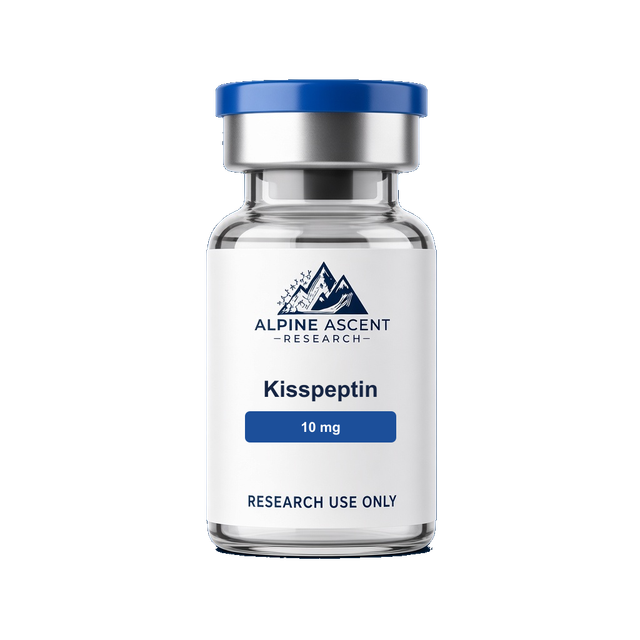
10 mg vial. Format: Lyophilized powder.
For educational and research purposes only. These materials are not approved to diagnose, treat, cure, or prevent any disease. Nothing on this page is a dose recommendation or medical advice. The Alpine Ascent data sheet is the reference copy for each compound.