Immunity
LL-37
Approved registered clients only.
Data sheet
LL-37
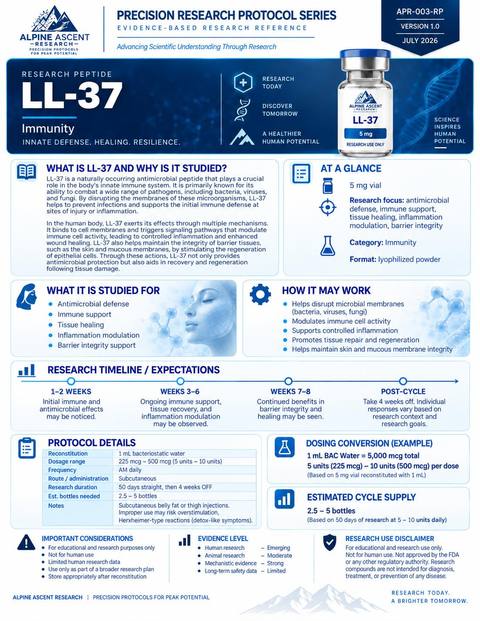
This preview is the one-page Alpine Ascent sheet for LL-37. It is the reference copy for reconstitution, frequency, and the figures printed on the sheet. Open it when you want the full page.
What it is
LL-37 is a naturally occurring antimicrobial peptide that plays a role in the body's innate immune system. It is primarily known for activity against a wide range of pathogens, including bacteria, viruses, and fungi, by disrupting microbial membranes. It also supports the initial immune defense at sites of injury or inflammation. In research models it binds cell membranes, modulates immune cell activity, and is studied for barrier integrity and wound healing.
What researchers study it for
- Antimicrobial defense
- Immune support
- Tissue healing
- Inflammation modulation
- Barrier integrity support
How it may work
- Helps disrupt microbial membranes, including bacteria, viruses, and fungi in research models
- Modulates immune cell activation
- Supports controlled inflammation
- Promotes tissue repair and regeneration
- Helps maintain skin and mucous membrane integrity
Research timeline
1–2 weeks
Initial immune and antimicrobial effects may be noticed.
Weeks 3–6
Ongoing immune support, tissue recovery, and inflammation modulation may be observed.
Weeks 7–8
Continued benefits in barrier integrity and healing may be seen.
Post-cycle
The sheet describes a break of about 4 weeks off. Individual responses vary with the research context.
5 mg research protocol
- Reconstitution
- 1 mL bacteriostatic water
- Final concentration
- 5 mg/mL (5,000 mcg/mL)
- Dosage range
- 250–500 mcg (5–10 units)
- Frequency
- The sheet lists both 5 days on and 2 days off, and a separate 4 weeks on and 1 week off pattern
- Research duration
- Up to about 50 days straight, then 4 weeks off, as one pattern on the sheet
- Administration
- Subcutaneous, as noted on the sheet
- Notes
- The sheet notes local irritation can occur and says to hold the dose if marked irritation develops.
Research duration on the sheet: The sheet describes cycles of about 4–8 weeks, or up to about 50 days, followed by time off.
Reconstitution
- 5 mg + 1 mL bacteriostatic water = 5 mg/mL.
- 5 units = 250 mcg. 10 units = 500 mcg.
Titration notes
- The sheet gives a range of 250–500 mcg rather than a weekly escalation.
- 5 units = 250 mcg and 10 units = 500 mcg at this concentration.
Important considerations
- For educational and research purposes only.
- Not for human use.
- Limited human-research data.
- Use only as part of a broader research protocol.
- Store appropriately after reconstitution.
Commonly reported effects
- The sheet notes possible injection-site irritation.
Evidence summary
- Human research
- Emerging
- Animal research
- Moderate
- Mechanistic evidence
- Strong
- Long-term safety data
- Limited
References
Completed published studies are listed below and labeled as in vitro, animal, or human research. Favorable and unfavorable results are both included, including cancer studies. This is not every paper on the compound, and it is not a recommendation or a dose.
Cancer results go both ways. Full-length LL-37 increased ovarian cancer cell growth and, in a separate study, slowed colon cancer. A short fragment of LL-37 also killed colon cancer cells in culture.
- Wound healing activity of the human antimicrobial peptide LL-37Animal
Mice treated with a steroid that slows repair. Topical LL-37 increased new blood vessels and skin closure.
- LL-37 increases ovarian cancer cell proliferation and invasionIn vitro
Ovarian tumors contained more LL-37 than normal ovary. Adding LL-37 to ovarian cancer cells increased division, movement, and invasion.
- LL-37 promotes ovarian tumor growth by recruiting stromal cellsAnimal
Mice with ovarian tumor grafts. Blocking LL-37 reduced stromal-cell entry into the tumor and slowed tumor growth.
- LL-37 suppresses colon cancer through a cell-death pathwayIn vitro
Colon cancer cells died after LL-37 exposure. Mice lacking the related cathelicidin peptide grew more colon tumors after a carcinogen.
- FK-16, a fragment of LL-37, and colon cancer cellsIn vitro
Colon cancer cells in culture. FK-16, residues 17–32 of LL-37 rather than the full peptide, killed the cells through two death pathways.
Available strength
5 mg vial. Format: Lyophilized powder.
For educational and research purposes only. These materials are not approved to diagnose, treat, cure, or prevent any disease. Nothing on this page is a dose recommendation or medical advice. The Alpine Ascent data sheet is the reference copy for each compound.