Metabolic health
MOTS-c
Approved registered clients only.
Data sheet
MOTS-c
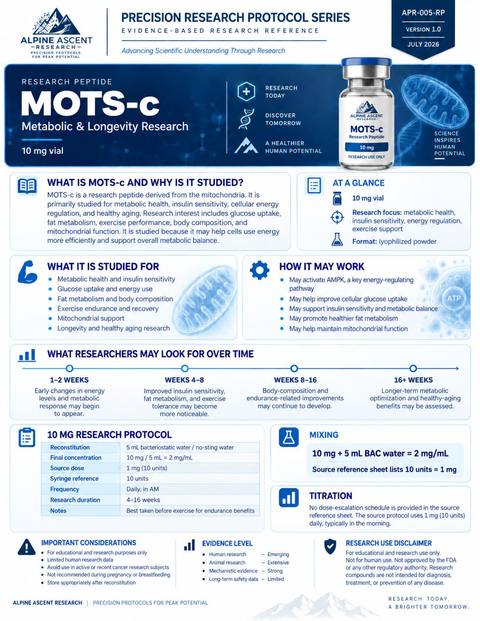
This preview is the one-page Alpine Ascent sheet for MOTS-c. It is the reference copy for reconstitution, frequency, and the figures printed on the sheet. Open it when you want the full page.
What it is
MOTS-c is a research peptide derived from the mitochondria. It is primarily studied for metabolic health, insulin sensitivity, cellular energy regulation, and healthy aging. Research interest includes glucose uptake, fat metabolism, exercise performance, body composition, and mitochondrial function. It is studied because it may help cells use energy more efficiently and support overall metabolic balance.
What researchers study it for
- Metabolic health and insulin sensitivity
- Glucose uptake and energy use
- Fat metabolism and body composition
- Exercise endurance and recovery
- Mitochondrial support
- Longevity and healthy-aging research
How it may work
- May activate AMPK, a key energy-regulating pathway
- May help improve cellular glucose uptake
- May support insulin sensitivity and metabolic balance
- May promote healthier fat metabolism
- May help maintain mitochondrial function
Research timeline
1–2 weeks
Early changes in energy levels and metabolic response may begin to appear.
Weeks 4–8
Improved insulin sensitivity, fat metabolism, and exercise tolerance may become more noticeable.
Weeks 8–16
Body-composition and endurance-related improvements may continue to develop.
16+ weeks
Longer-term metabolic optimization and healthy-aging benefits may be evaluated.
10 mg research protocol
- Reconstitution
- 5 mL bacteriostatic water or no-sting water
- Final concentration
- 2 mg/mL
- Frequency
- Once daily, in the morning
- Research duration
- 4–16 weeks
- Notes
- The sheet notes it is best taken before exercise for endurance benefits. Read the data sheet for the syringe-unit marking.
Research duration on the sheet: 4–16 weeks on the source sheet.
Reconstitution
- 10 mg + 5 mL bacteriostatic water = 2 mg/mL.
- Syringe-unit markings are printed on the data sheet and should be read there.
Titration notes
- No dose-escalation schedule is provided on the source reference sheet.
Important considerations
- For educational and research purposes only.
- Limited human-research data.
- Avoid use in active or recent cancer research subjects.
- Not recommended during pregnancy or breastfeeding.
- Store appropriately after reconstitution.
Evidence summary
- Human research
- Emerging
- Animal research
- Extensive
- Mechanistic evidence
- Strong
- Long-term safety data
- Limited
References
Completed published studies are listed below and labeled as in vitro, animal, or human research. Favorable and unfavorable results are both included, including cancer studies. This is not every paper on the compound, and it is not a recommendation or a dose.
Metabolic work is in mice. A completed human trial was not identified. One cancer paper reported slower ovarian cancer growth in cells and in mice.
- MOTS-c promotes metabolic homeostasis and reduces obesity and insulin resistanceAnimal
Mice. MOTS-c treatment prevented high-fat-diet weight gain and improved insulin sensitivity.
- MOTS-c suppresses ovarian cancer progressionAnimal
Ovarian cancer cells divided, moved, and invaded less, and more of them died. In mice, MOTS-c slowed tumor growth. In tumor samples, lower MOTS-c tracked with shorter survival. That patient comparison is not a treatment trial.
Available strength
10 mg vial. Format: Lyophilized powder.
For educational and research purposes only. These materials are not approved to diagnose, treat, cure, or prevent any disease. Nothing on this page is a dose recommendation or medical advice. The Alpine Ascent data sheet is the reference copy for each compound.