Connection & calm
Oxytocin
Approved registered clients only.
Data sheet
Oxytocin
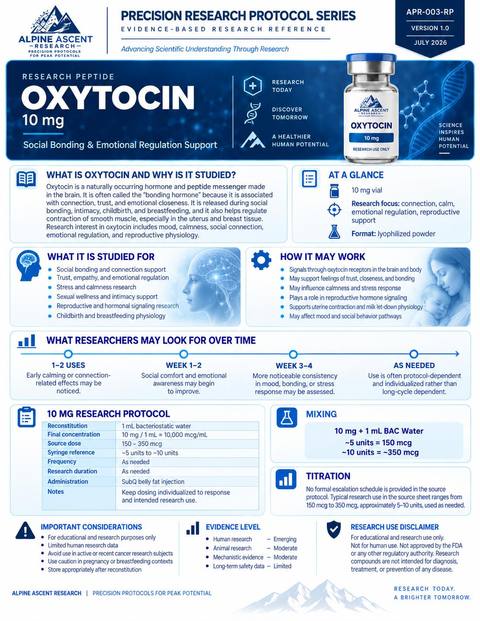
This preview is the one-page Alpine Ascent sheet for Oxytocin. It is the reference copy for reconstitution, frequency, and the figures printed on the sheet. Open it when you want the full page.
What it is
Oxytocin is a naturally occurring hormone and peptide messenger made in the brain. It is often called the bonding hormone because it is associated with connection, trust, and emotional closeness. It is released during social bonding, intimacy, childbirth, and breastfeeding, and it also helps regulate contraction of smooth muscle, especially in the uterus and breast tissue. Research interest includes mood, calmness, social connection, emotional regulation, and reproductive physiology.
What researchers study it for
- Social bonding and connection support
- Trust, empathy, and emotional regulation
- Stress and calmness research
- Sexual wellness and intimacy support
- Reproductive and hormonal signaling research
- Childbirth and breastfeeding physiology
How it may work
- Signals through oxytocin receptors in the brain and body
- May support feelings of trust, calmness, and bonding
- May influence calmness and stress response
- Plays a role in reproductive hormone signaling
- Supports uterine contraction and milk let-down physiology
- May affect mood and social-behavior pathways
Research timeline
1–2 uses
Early calming or connection-related effects may be noticed.
Week 1–2
Social comfort and emotional awareness may begin to improve.
Week 3–4
More noticeable consistency in mood, bonding, or stress response may be observed.
As needed
Use within this protocol is dependent and individualized rather than a long, fixed cycle.
10 mg research protocol
- Reconstitution
- 1 mL bacteriostatic water
- Final concentration
- 10 mg/mL (10,000 mcg/mL)
- Frequency
- As needed
- Administration
- Subcutaneous injection, as noted on the sheet
- Notes
- Dosing is individualized to response and research goals. Read the data sheet for the syringe-unit range.
Research duration on the sheet: As needed, rather than a fixed multi-week cycle.
Reconstitution
- 10 mg + 1 mL bacteriostatic water = 10 mg/mL.
- Unit markings and the microgram range are printed on the data sheet.
Titration notes
- No formal escalation schedule is included on the source protocol.
- The sheet describes use as needed, individualized to response.
Important considerations
- For educational and research purposes only.
- Limited human-research data.
- Avoid use in active or recent cancer research subjects.
- Use caution in pregnancy or breastfeeding contexts.
- Store appropriately after reconstitution.
Evidence summary
- Human research
- Emerging
- Animal research
- Extensive
- Mechanistic evidence
- Moderate
- Long-term safety data
- Limited
References
Completed published studies are listed below and labeled as in vitro, animal, or human research. Favorable and unfavorable results are both included, including cancer studies. This is not every paper on the compound, and it is not a recommendation or a dose.
The completed cancer-cell studies linked here found more movement or invasion. Other breast-cancer cell lines in the wider literature have gone the other way.
- Oxytocin increases trust in humansHuman
Adults. One intranasal dose increased trusting transfers in a money game, without a general increase in risk-taking.
- Oxytocin and breast-tumor endothelial cellsIn vitro
Oxytocin increased division and movement of endothelial cells taken from human breast tumors, as well as ordinary skin endothelial cells.
- Copper-bound oxytocin and triple-negative breast cancer cellsIn vitro
In MDA-MB-231 breast cancer cells, copper plus oxidized oxytocin increased invasion. Copper plus reduced oxytocin increased migration. The direction depended on the form of the peptide.
Available strength
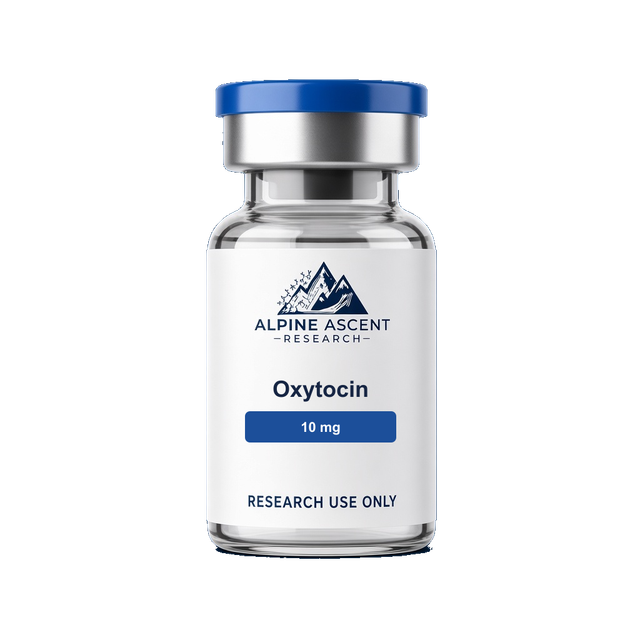
10 mg vial. Format: Lyophilized powder.
For educational and research purposes only. These materials are not approved to diagnose, treat, cure, or prevent any disease. Nothing on this page is a dose recommendation or medical advice. The Alpine Ascent data sheet is the reference copy for each compound.