Sexual wellness
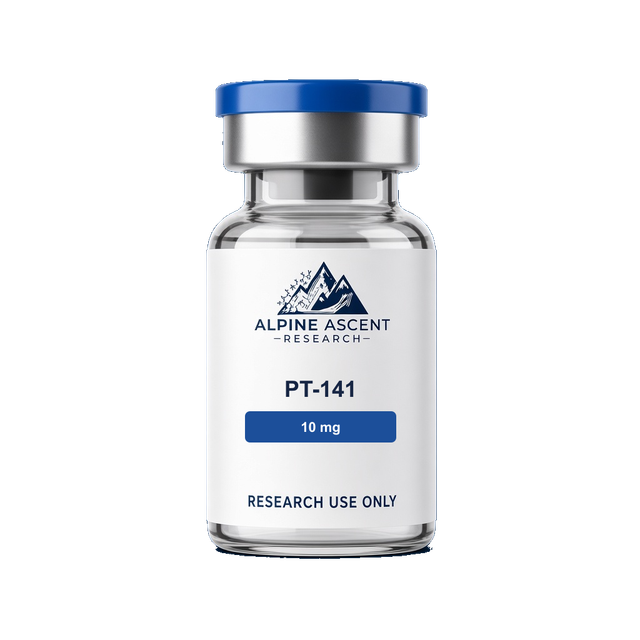
PT-141
Approved registered clients only.
Data sheet
PT-141
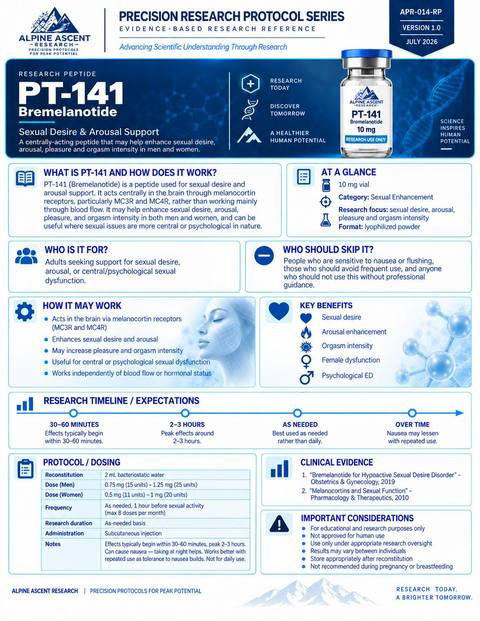
This preview is the one-page Alpine Ascent sheet for PT-141. It is the reference copy for reconstitution, frequency, and the figures printed on the sheet. Open it when you want the full page.
What it is
PT-141 (bremelanotide) is a peptide studied for sexual desire and arousal support. It acts centrally in the brain through melanocortin receptors, particularly MC3R and MC4R, rather than working mainly through blood flow. It is studied for sexual desire, arousal, pleasure, and orgasm intensity in both men and women, and can be useful where sexual issues are more central or psychological in nature.
What researchers study it for
- Sexual desire
- Arousal and pleasure intensity
- Orgasm intensity
- Female sexual-desire research
- Central or psychological sexual dysfunction
How it may work
- Acts in the brain via melanocortin receptors MC3R and MC4R
- Studied for sexual desire and arousal
- May increase pleasure and orgasm intensity
- Studied where sexual dysfunction is more central or psychological
- Works independently of blood flow or hormonal status
Research timeline
30–60 minutes
Effects typically begin within 30–60 minutes.
2–3 hours
Peak effects are described around 2–3 hours.
As needed
Best used as needed rather than daily.
Over time
Nausea may lessen with repeated use.
10 mg research protocol
- Reconstitution
- 2 mL bacteriostatic water
- Final concentration
- 5 mg/mL
- Dose range, men
- 0.75 mg (15 units) to 1.25 mg (25 units)
- Dose range, women
- 0.5 mg (10 units) to 1 mg (20 units)
- Frequency
- As needed, 1–2 times per week, with a maximum of 8 doses per month on the sheet
- Administration
- Subcutaneous injection
- Notes
- Not appropriate for daily use. The sheet notes nausea can occur, often at the right side of the abdomen, and that tolerance to nausea may build.
Research duration on the sheet: As needed, up to 8 doses per month on the source sheet.
Reconstitution
- 10 mg + 2 mL bacteriostatic water = 5 mg/mL.
- 15 units = 0.75 mg. 25 units = 1.25 mg. 10 units = 0.5 mg. 20 units = 1 mg.
Titration notes
- The sheet gives a range rather than a weekly escalation.
- Men: 0.75–1.25 mg. Women: 0.5–1 mg. As needed, not daily.
Important considerations
- For educational and research purposes only.
- Not appropriate for daily use.
- People who are sensitive to nausea or flushing, who should avoid frequent use, or who should not use this without professional guidance are called out on the sheet.
- Not recommended during pregnancy or breastfeeding.
- Store appropriately after reconstitution.
Commonly reported effects
- Nausea is the effect most clearly noted on the sheet. It may lessen with repeated use.
Evidence summary
- Human research
- Published clinical literature, see references
- Mechanistic evidence
- Central melanocortin pathway
References
Completed published studies are listed below and labeled as in vitro, animal, or human research. Favorable and unfavorable results are both included, including cancer studies. This is not every paper on the compound, and it is not a recommendation or a dose.
A completed cancer study of this compound was not identified.
- Bremelanotide for hypoactive sexual desire disorder: two randomized phase 3 trialsHuman
Premenopausal women. As-needed bremelanotide, the same molecule as PT-141, increased desire scores and reduced related distress compared with placebo. Nausea, flushing, and headache were more common.
Available strength
10 mg vial. Format: Lyophilized powder.
For educational and research purposes only. These materials are not approved to diagnose, treat, cure, or prevent any disease. Nothing on this page is a dose recommendation or medical advice. The Alpine Ascent data sheet is the reference copy for each compound.