Metabolic health
Retatrutide
Approved registered clients only.
Data sheet
Retatrutide
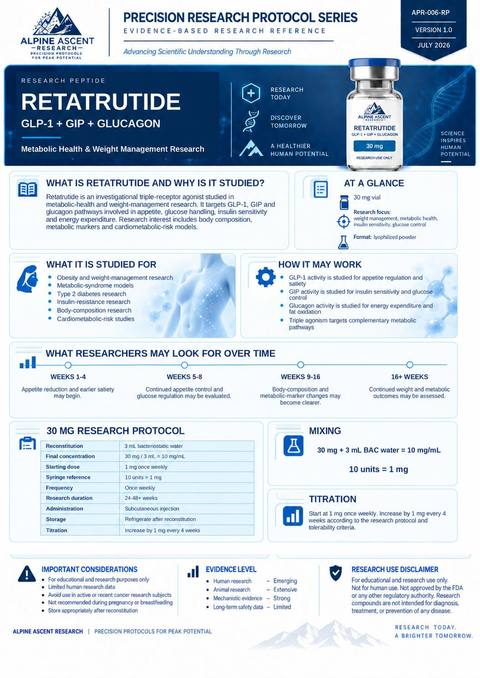
This preview is the one-page Alpine Ascent sheet for Retatrutide. It is the reference copy for reconstitution, frequency, and the figures printed on the sheet. Open it when you want the full page.
What it is
Retatrutide is an investigational triple-receptor agonist studied in metabolic-health and weight-management research. It targets GLP-1, GIP, and glucagon pathways involved in appetite, glucose handling, insulin sensitivity, and energy expenditure. Research interest includes body composition, metabolic markers, and cardiometabolic-risk models.
What researchers study it for
- Obesity and weight-management research
- Metabolic-syndrome models
- Type 2 diabetes research
- Insulin-resistance research
- Body-composition research
- Cardiometabolic-risk studies
How it may work
- GLP-1 activity is studied for appetite regulation and satiety
- GIP activity is studied for insulin sensitivity and glucose control
- Glucagon activity is studied for energy expenditure and fat oxidation
- Triple agonism targets complementary metabolic pathways
Research timeline
Weeks 1–4
Appetite reduction and early satiety may be earlier.
Weeks 5–8
Continued appetite control and glucose regulation may be evaluated.
Weeks 9–16
Body-composition and metabolic-marker changes may become clearer.
16+ weeks
Continued weight and metabolic outcomes may be assessed.
30 mg research protocol
- Reconstitution
- 3 mL bacteriostatic water
- Final concentration
- 10 mg/mL
- Starting dose
- 1 mg once weekly
- Syringe reference
- 10 units = 1 mg
- Frequency
- Once weekly
- Titration
- Increase by 1 mg every 4 weeks
- Storage
- Refrigerate after reconstitution
- Administration
- Subcutaneous injection
Research duration on the sheet: The observation window on the sheet runs through 16+ weeks.
Reconstitution
- 30 mg + 3 mL bacteriostatic water = 10 mg/mL.
- 10 units = 1 mg.
Titration notes
- Starts at 1 mg once weekly. Increase by 1 mg every 4 weeks according to the research protocol and tolerability criteria on the sheet.
Important considerations
- For educational and research purposes only.
- Limited human-research data relative to approved medicines in this class.
- Avoid use in active or recent cancer research subjects.
- Not recommended during pregnancy or breastfeeding.
- Store appropriately after reconstitution.
Evidence summary
- Human research
- Emerging
- Animal research
- Extensive
- Mechanistic evidence
- Strong
- Long-term safety data
- Limited
References
Completed published studies are listed below and labeled as in vitro, animal, or human research. Favorable and unfavorable results are both included, including cancer studies. This is not every paper on the compound, and it is not a recommendation or a dose.
The cancer results are from obese mice, not people with lung cancer. Tumor volume in the lung-cancer model was about 17-fold lower than in untreated mice, which is a much larger change than a 17% reduction.
- Triple-hormone-receptor agonist retatrutide for obesity — a phase 2 trialHuman
Adults with obesity or overweight. Weekly retatrutide for 48 weeks produced greater weight reduction than placebo. Gastrointestinal effects were the most common.
- Retatrutide in mouse models of obesity-associated pancreatic and lung cancerAnimal
Obese mice. In a pancreatic cancer model, tumors were smaller, about 14-fold lower in volume than untreated mice. In a Lewis lung carcinoma model, fewer mice grew a tumor, tumors started later, and tumor volume was about 17-fold lower than in untreated mice.
Available strength
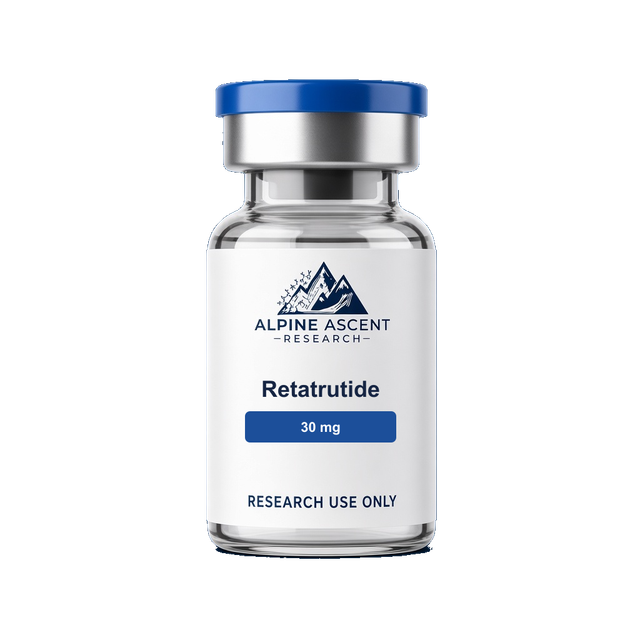
30 mg vial. Format: Lyophilized powder.
For educational and research purposes only. These materials are not approved to diagnose, treat, cure, or prevent any disease. Nothing on this page is a dose recommendation or medical advice. The Alpine Ascent data sheet is the reference copy for each compound.