Cognitive
Semax
Approved registered clients only.
Data sheet
Semax
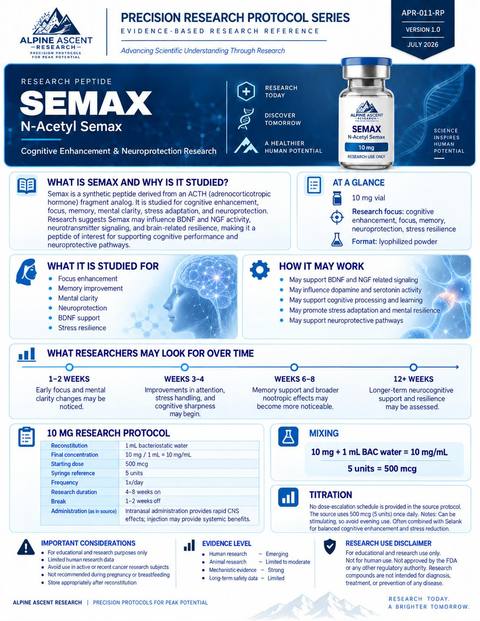
This preview is the one-page Alpine Ascent sheet for Semax. It is the reference copy for reconstitution, frequency, and the figures printed on the sheet. Open it when you want the full page.
What it is
Semax is a synthetic peptide derived from an ACTH (adrenocorticotropic hormone) fragment. It is studied for cognitive enhancement, focus, memory, mental clarity, stress adaptation, and neuroprotection. Research suggests it may influence BDNF and NGF activity, neuroplasticity, and brain-related resilience.
What researchers study it for
- Focus enhancement
- Memory improvement
- Mental clarity
- Neuroprotection
- BDNF support
- Stress resilience
How it may work
- May support BDNF and NGF-related signaling
- May influence dopamine and serotonin activity
- May support cognitive processing and learning
- May promote stress adaptation and mental resilience
- May support neuroprotective pathways
Research timeline
1–2 weeks
Early focus and mental-clarity changes may be noticed.
Weeks 3–4
Improvements in attention, stress handling, and cognitive sharpness may begin.
Weeks 6–8
Memory support and broader nootropic effects may become more noticeable.
12+ weeks
Longer-term neurocognitive support and resilience may be assessed.
10 mg research protocol
- Reconstitution
- 1 mL bacteriostatic water
- Final concentration
- 10 mg/mL
- Starting dose
- 500 mcg
- Syringe reference
- 5 units = 500 mcg
- Frequency
- 1–2 times daily
- Research duration
- 4–8 weeks
- Break
- 1–2 weeks off
- Administration
- Intranasal administration is the route described for central effects. The sheet notes injection may provide systemic effects.
Research duration on the sheet: 4–8 weeks, then 1–2 weeks off, on the source sheet.
Reconstitution
- 10 mg + 1 mL bacteriostatic water = 10 mg/mL.
- 5 units = 500 mcg.
Titration notes
- No dose-escalation schedule is provided.
- The source uses 500 mcg (5 units) once daily. The sheet notes the dose can be stimulating, so later-day use should be considered in the research design.
Important considerations
- For educational and research purposes only.
- Limited human-research data.
- Avoid use in active or recent cancer research subjects.
- Not recommended during pregnancy or breastfeeding.
- Store appropriately after reconstitution.
- The sheet notes Semax can feel stimulating, especially later in the day.
Commonly reported effects
- The sheet notes that Semax can feel stimulating.
Evidence summary
- Human research
- Emerging
- Animal research
- Limited to moderate
- Mechanistic evidence
- Strong
- Long-term safety data
- Limited
References
Completed published studies are listed below and labeled as in vitro, animal, or human research. Favorable and unfavorable results are both included, including cancer studies. This is not every paper on the compound, and it is not a recommendation or a dose.
A completed cancer study of this compound was not identified.
- Semax in the acute period of hemispheric ischemic strokeHuman
People in the first days after an ischemic stroke. Adding semax to usual care was associated with faster recovery of neurological function.
- Semax during rehabilitation after ischemic strokeHuman
110 people after ischemic stroke. Semax was associated with higher BDNF and better day-to-day function scores.
- Nootropic effects of semax in ratsAnimal
Rats. Intranasal semax improved learning on a passive-avoidance test at a lower dose than an injection.
Available strength
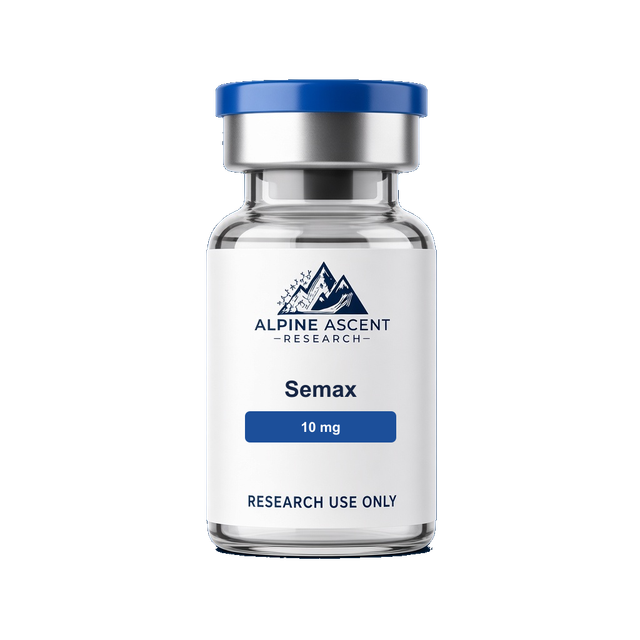
10 mg vial. Format: Lyophilized powder.
For educational and research purposes only. These materials are not approved to diagnose, treat, cure, or prevent any disease. Nothing on this page is a dose recommendation or medical advice. The Alpine Ascent data sheet is the reference copy for each compound.