Mitochondrial health
SS-31
Approved registered clients only.
Data sheet
SS-31
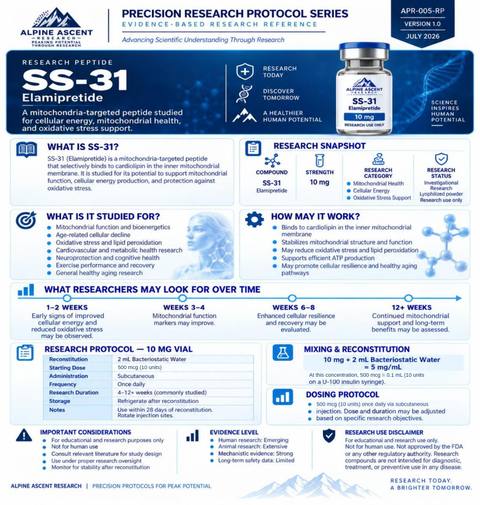
This preview is the one-page Alpine Ascent sheet for SS-31. It is the reference copy for reconstitution, frequency, and the figures printed on the sheet. Open it when you want the full page.
What it is
SS-31 (elamipretide) is a mitochondria-targeted peptide that selectively binds to cardiolipin in the inner mitochondrial membrane. It is studied for its potential to support mitochondrial function, cellular energy production, and protection against oxidative stress.
What researchers study it for
- Mitochondrial function and bioenergetics
- Age-related cellular decline
- Oxidative stress and lipid peroxidation
- Cardiovascular and metabolic health research
- Neuroprotection and cognitive health
- Exercise performance and recovery
- General healthy-aging research
How it may work
- Binds to cardiolipin in the inner mitochondrial membrane
- Stabilizes mitochondrial structure and function
- May reduce oxidative stress and lipid peroxidation
- Supports efficient ATP production
- May promote cellular resilience and healthy-aging pathways
Research timeline
1–2 weeks
Early signs of improved cellular energy and reduced oxidative stress may be observed.
Weeks 3–4
Mitochondrial function and recovery markers may improve.
Weeks 6–8
Enhanced cellular resilience and metabolic efficiency may be evaluated.
12+ weeks
Continued mitochondrial support and long-term benefits may be assessed.
10 mg research protocol
- Reconstitution
- 2 mL bacteriostatic water
- Final concentration
- 5 mg/mL
- Starting dose
- 500 mcg (10 units) once daily
- Administration
- Subcutaneous injection
- Frequency
- Once daily
- Research duration
- 4–12 weeks, as commonly studied on the sheet
- Storage
- Refrigerate after reconstitution. Use within 28 days. Rotate injection sites.
Research duration on the sheet: 4–12 weeks is the window commonly noted on the sheet.
Reconstitution
- 10 mg + 2 mL bacteriostatic water = 5 mg/mL.
- At this concentration, 500 mcg (0.5 mg) is 10 units on a U-100 syringe.
Titration notes
- The source sheet uses 500 mcg (10 units) once daily by subcutaneous injection.
- Dose and duration may be adjusted based on the specific research protocol.
Important considerations
- For educational and research purposes only.
- Not for human use.
- Consult relevant literature for study design.
- Use under proper research oversight.
- Monitor for stability after reconstitution.
Evidence summary
- Human research
- Emerging
- Animal research
- Extensive
- Mechanistic evidence
- Strong
- Long-term safety data
- Limited
References
Completed published studies are listed below and labeled as in vitro, animal, or human research. Favorable and unfavorable results are both included, including cancer studies. This is not every paper on the compound, and it is not a recommendation or a dose.
Elamipretide is the clinical name for SS-31. The controlled phase did not meet its main endpoints. The longer follow-up, which was not placebo-controlled, reported later improvement. In mice with colon tumors, SS-31 improved some wasting measures and did not change tumor size.
- Elamipretide in Barth syndrome: a randomized trial and open-label extensionHuman
People with Barth syndrome. Twelve weeks against placebo did not improve the walk test or the symptom score. By 36 weeks of continued open-label treatment, walk distance and symptom scores had improved.
- Long-term elamipretide in Barth syndrome: 168-week open-label resultsHuman
The same Barth syndrome group, followed without a placebo comparison. Walking distance and fatigue scores remained improved through 168 weeks.
- SS-31 in cancer- and chemotherapy-related muscle wastingAnimal
Mice with colon tumors, including mice also given oxaliplatin and 5-fluorouracil. SS-31 partly improved body weight, muscle energy use, and strength at some time points. It did not change tumor size, and the benefit faded in late wasting.
Available strength
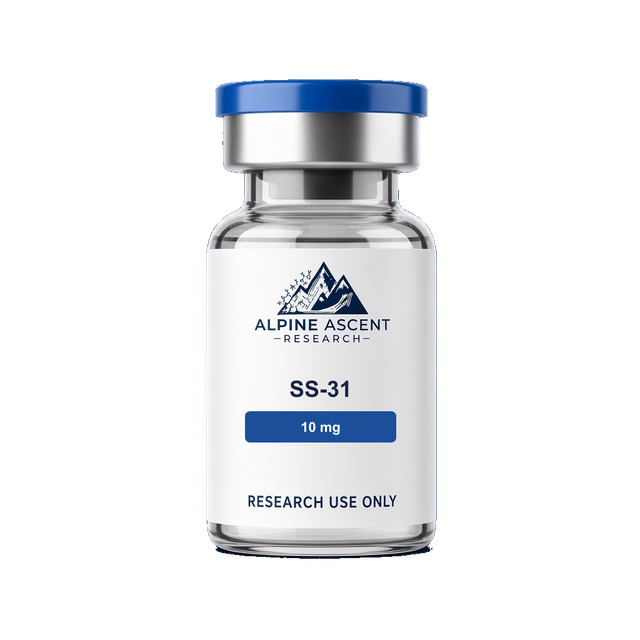
10 mg vial. Format: Lyophilized powder.
For educational and research purposes only. These materials are not approved to diagnose, treat, cure, or prevent any disease. Nothing on this page is a dose recommendation or medical advice. The Alpine Ascent data sheet is the reference copy for each compound.