Recovery
BPC-157
Approved registered clients only.
Data sheet
BPC-157
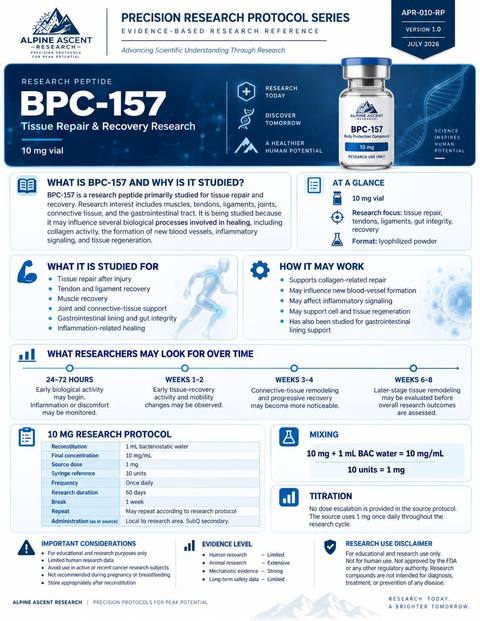
This preview is the one-page Alpine Ascent sheet for BPC-157. It is the reference copy for reconstitution, frequency, and the figures printed on the sheet. Open it when you want the full page.
What it is
BPC-157 is a research peptide studied primarily for tissue repair and recovery. Research interest includes muscles, tendons, ligaments, joints, connective tissue, and the gastrointestinal lining. It is being studied because it may influence several biological processes involved in healing, including collagen activity, formation of new blood vessels, inflammatory signaling, and tissue regeneration.
What researchers study it for
- Tissue repair after injury
- Tendon and ligament recovery
- Muscle recovery
- Joint and connective-tissue support
- Gastrointestinal lining and gut integrity
- Inflammation-related healing
How it may work
- Studied for support of collagen-related repair
- May influence new blood-vessel formation
- May affect inflammatory signaling
- May support cell and tissue regeneration
- Also studied for gastrointestinal lining support
Research timeline
24–72 hours
Early biological activity may begin. Inflammation or discomfort may be monitored.
Weeks 1–2
Early tissue-recovery changes and mobility changes may be observed.
Weeks 3–4
Connective-tissue remodeling and progressive recovery may become more noticeable.
Weeks 6–8
Later-stage tissue remodeling may be evaluated before overall research outcomes are assessed.
10 mg research protocol
- Reconstitution
- 1 mL bacteriostatic water
- Final concentration
- 10 mg/mL
- Source dose
- 1 mg
- Syringe reference
- 10 units = 1 mg on a U-100 syringe
- Frequency
- Once daily
- Research duration
- 20 days
- Administration
- Subcutaneous, local to the research area, as noted on the sheet
Research duration on the sheet: 20 days, and the sheet notes the cycle may be repeated according to the research protocol.
Reconstitution
- 10 mg + 1 mL bacteriostatic water = 10 mg/mL.
- 10 units = 1 mg.
Titration notes
- No dose escalation is provided on the source protocol.
- The source uses 1 mg once daily through the research cycle.
Important considerations
- For educational and research purposes only.
- Limited human-research data.
- Avoid use in active or recent cancer research subjects.
- Not recommended during pregnancy or breastfeeding.
- Store appropriately after reconstitution.
Evidence summary
- Human research
- Limited
- Animal research
- Extensive
- Mechanistic evidence
- Strong
- Long-term safety data
- Limited
References
Completed published studies are listed below and labeled as in vitro, animal, or human research. Favorable and unfavorable results are both included, including cancer studies. This is not every paper on the compound, and it is not a recommendation or a dose.
Repair reports are animal studies. A completed human repair trial was not identified. The melanoma note is a conference abstract. In mice that already had colon tumors, BPC-157 improved wasting measures and did not produce a statistically significant drop in tumor volume.
- BPC 157 accelerates healing of a transected rat Achilles tendonAnimal
Rats with a cut Achilles tendon recovered more function, strength, and collagen organization than saline controls.
- BPC 157 promoted tendon-to-bone healing after Achilles detachment in ratsAnimal
Rats. The tendon-to-bone attachment healed more completely, including when a corticosteroid was also given.
- BPC 157 as therapy for a transected quadriceps muscle in the ratAnimal
Rats. A fully cut quadriceps regained more strength, walking function, and muscle continuity over 72 days.
- BPC 157 increases new-vessel growth through VEGFR2In vitro
Human endothelial cells formed more vessel-like tubes, and rats grew more vessels in an ischemic limb. The study did not implant a tumor. New-vessel growth is the result cancer researchers watch.
- BPC 157 and growth of a human melanoma cell lineIn vitro
This is a conference abstract, not a full paper. In cultured human melanoma cells, BPC-157 was reported to leave fewer cells in the dividing phase. A follow-up tumor study was not identified.
- BPC 157 in mice with colon-cancer cachexiaAnimal
Mice with C26 colon tumors. The report describes better body weight, less muscle wasting, and lower IL-6 and TNF-alpha. Tumor volume was lower on average, and that difference was not statistically significant.
Available strength
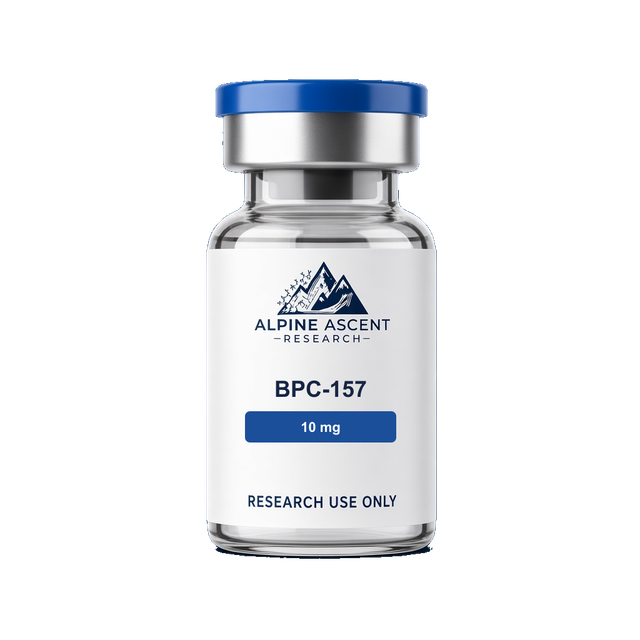
10 mg vial. Format: Lyophilized powder.
For educational and research purposes only. These materials are not approved to diagnose, treat, cure, or prevent any disease. Nothing on this page is a dose recommendation or medical advice. The Alpine Ascent data sheet is the reference copy for each compound.