Recovery & skin
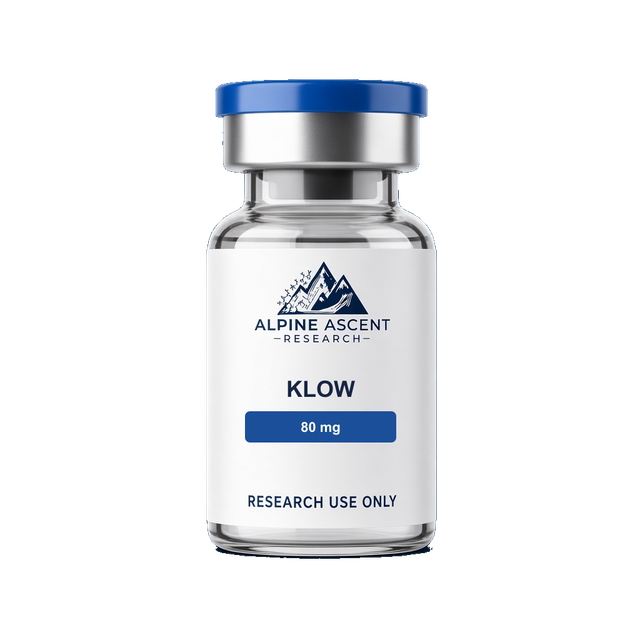
KLOW
Approved registered clients only.
Data sheet
KLOW
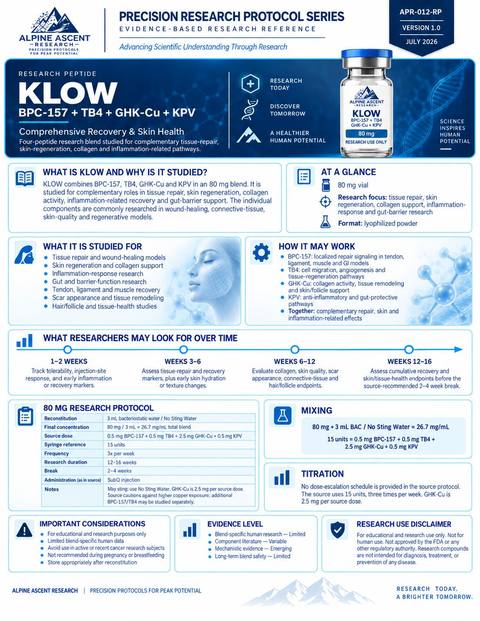
This preview is the one-page Alpine Ascent sheet for KLOW. It is the reference copy for reconstitution, frequency, and the figures printed on the sheet. Open it when you want the full page.
What it is
KLOW combines BPC-157, TB-500 (TB4), GHK-Cu, and KPV in an 80 mg blend. It is studied for complementary roles in tissue repair, skin regeneration, collagen activity, inflammation-related recovery, and gut-barrier support. The individual components are commonly researched in wound healing, connective tissue, skin quality, and regenerative models.
What researchers study it for
- Tissue repair and wound-healing models
- Skin regeneration and collagen support
- Inflammation-response research
- Gut and barrier-function research
- Tendon, ligament, and muscle recovery
- Scar appearance and tissue remodeling
- Hair follicle and skin-health studies
How it may work
- BPC-157 is studied for localized repair signaling in tendon, ligament, muscle, and gut models
- TB-500 is studied for cell migration, angiogenesis, and tissue-regeneration pathways
- GHK-Cu is studied for collagen activity, tissue remodeling, and skin-quality support
- KPV is studied for inflammatory and gut-barrier pathways
- Together, the blend is researched for complementary repair, skin, and inflammation-related effects
Research timeline
1–2 weeks
Track tolerability, injection-site response, and early inflammation or recovery markers.
Weeks 3–6
Assess tissue repair and recovery markers, and skin texture or texture changes.
Weeks 6–12
Evaluate collagen, skin quality, scar appearance, connective tissue, and hair-follicle endpoints.
Weeks 12–16
Assess cumulative recovery and skin-health endpoints before a defined break.
80 mg research protocol
- Reconstitution
- 3 mL bacteriostatic water or no-sting water
- Final concentration
- About 26.7 mg/mL total blend
- Source dose
- 15 units, three times per week
- Frequency
- 3 times per week
- Research duration
- 12–16 weeks
- Break
- 2–4 weeks
- Administration
- Subcutaneous, as noted on the sheet
Research duration on the sheet: 12–16 weeks, followed by a 2–4 week break on the source sheet.
Reconstitution
- 80 mg + 3 mL bacteriostatic or no-sting water = about 26.7 mg/mL.
- The source reference is 15 units, three times per week.
Titration notes
- No dose-escalation schedule is specified on the source protocol.
- Read the data sheet for the per-component split at 15 units.
Important considerations
- For educational and research purposes only.
- Limited blend-specific human data.
- Avoid use in active or recent cancer research subjects.
- Not recommended during pregnancy or breastfeeding.
- Store appropriately after reconstitution.
Evidence summary
- Human blend research
- Limited
- Component literature
- Varies
- Mechanistic evidence
- Emerging
- Long-term blend safety
- Limited
References
Completed published studies are listed below and labeled as in vitro, animal, or human research. Favorable and unfavorable results are both included, including cancer studies. This is not every paper on the compound, and it is not a recommendation or a dose.
No completed study of this blend as one product was identified. The links are completed studies of peptides in the blend.
- BPC 157 accelerates healing of a transected rat Achilles tendonAnimal
Rats with a cut Achilles tendon recovered more function, strength, and collagen organization than saline controls.
- BPC 157 increases new-vessel growth through VEGFR2In vitro
Human endothelial cells formed more vessel-like tubes, and rats grew more vessels in an ischemic limb. The study did not implant a tumor. New-vessel growth is the result cancer researchers watch.
- BPC 157 in mice with colon-cancer cachexiaAnimal
Mice with C26 colon tumors. The report describes better body weight, less muscle wasting, and lower IL-6 and TNF-alpha. Tumor volume was lower on average, and that difference was not statistically significant.
- Thymosin beta-4 accelerates wound healingAnimal
Rats. Full-thickness skin wounds closed faster, with more collagen and new blood vessels, after thymosin beta-4.
- Thymosin beta-4 in human pancreatic cancer cellsIn vitro
Pancreatic cancer cells made more thymosin beta-4 than normal duct cells. Adding the peptide increased inflammatory signals associated with tumor support.
- Topical glycyl-L-histidyl-L-lysine copper for diabetic neuropathic ulcersHuman
People with diabetic plantar ulcers. A topical copper-peptide gel closed more of the ulcer than the gel without the peptide. This was a skin gel, not an injection.
- GHK-Cu and growth of normal and irradiated fibroblastsIn vitro
Human skin fibroblasts, including cells taken after radiation for head and neck cancer. GHK-Cu sped doubling and raised early growth-factor output. These were repair cells, not cancer cells.
- GHK and cancer-related gene expressionIn vitro
A gene-expression database ranked GHK as reversing about 70% of a 54-gene pattern tied to aggressive colon cancer. The same paper reports that GHK-copper suppressed sarcoma 180 growth in mice. This is not a human cancer trial.
- GHK-Cu and gene expression in breast and prostate cancer cellsIn vitro
Stored profiles of MCF7 breast cancer cells and PC3 prostate cancer cells treated with GHK-Cu showed changes in cancer-related genes. The paper does not measure tumor size.
- KPV has anti-inflammatory potential in murine models of inflammatory bowel diseaseAnimal
Mice with experimental colitis regained weight sooner and had less colon inflammation after KPV.
- KPV and colitis-associated colon cancer in miceAnimal
Mice given a carcinogen and an inflammatory colon injury. KPV in the drinking water reduced tumor number, size, and burden. Mice lacking the PepT1 transporter did not get that protection.
Available strength
80 mg vial. Format: Lyophilized powder.
For educational and research purposes only. These materials are not approved to diagnose, treat, cure, or prevent any disease. Nothing on this page is a dose recommendation or medical advice. The Alpine Ascent data sheet is the reference copy for each compound.