Recovery
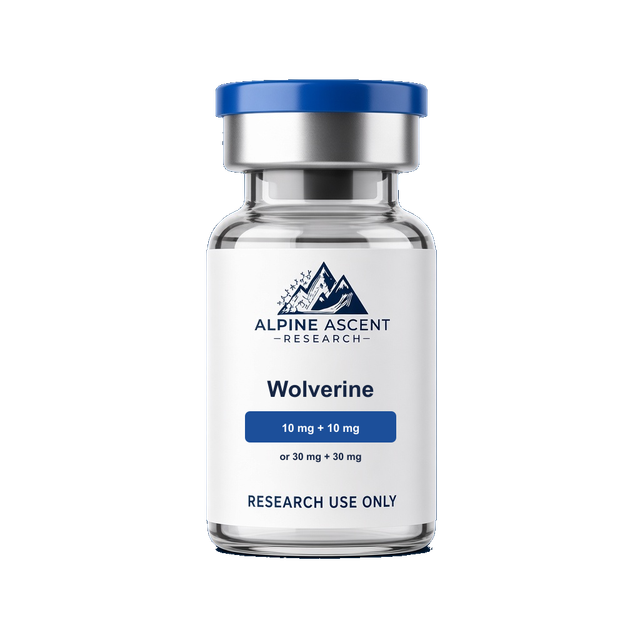
Wolverine Blend
Approved registered clients only.
Data sheet
Wolverine Blend
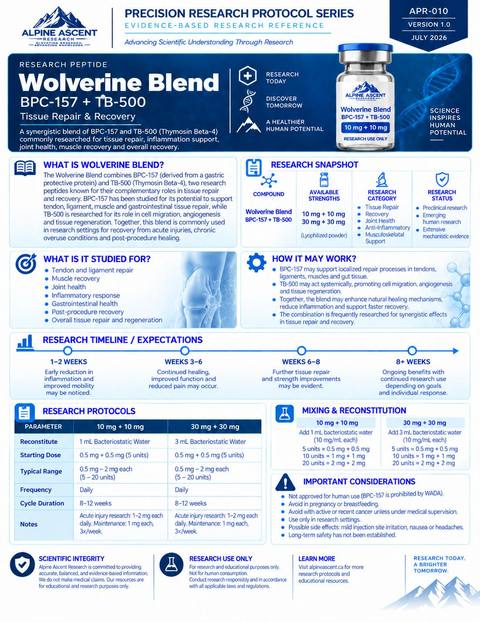
This preview is the one-page Alpine Ascent sheet for Wolverine Blend. It is the reference copy for reconstitution, frequency, and the figures printed on the sheet. Open it when you want the full page.
What it is
The Wolverine Blend combines BPC-157, derived from a gastric protective protein, and TB-500 (thymosin beta-4), two research peptides known for complementary roles in tissue repair and recovery. BPC-157 has been studied for its potential to support tendon, ligament, muscle, and gastrointestinal tissue repair. TB-500 is researched for cell migration, angiogenesis, and tissue regeneration. The blend is commonly used in research settings for recovery from acute injuries, chronic overuse conditions, and post-procedure healing.
What researchers study it for
- Tendon and ligament repair
- Muscle recovery
- Joint health
- Inflammatory response
- Gastrointestinal health
- Post-procedure recovery
- Overall tissue repair and recovery
How it may work
- BPC-157 may support localized repair processes in tendons, ligaments, muscles, and gut tissue
- TB-500 may support cell migration, angiogenesis, and tissue regeneration
- Together, the blend may enhance natural healing mechanisms, reduce inflammation, and support faster recovery
- The combination is frequently researched for synergistic effects in tissue repair and recovery
Research timeline
1–2 weeks
Early reduction in inflammation and improved mobility may be noticed.
Weeks 3–6
Continued healing, strength improvements, and reduced pain may occur.
Weeks 6–8
Further tissue repair and strength improvements may be evident.
8+ weeks
Ongoing benefits with continued research use, depending on goals and individual response.
Research protocols
- 10 mg + 10 mg reconstitution
- 1 mL bacteriostatic water
- 10 mg + 10 mg starting dose
- 0.5 mg + 0.5 mg (5 units)
- 10 mg + 10 mg typical range
- 0.5 mg to 2 mg each
- 30 mg + 30 mg reconstitution
- 3 mL bacteriostatic water
- 30 mg + 30 mg starting dose
- 0.5 mg + 0.5 mg (5 units)
- 30 mg + 30 mg typical range
- 0.5 mg to 2 mg each
- Frequency
- Daily
- Cycle duration
- 8–12 weeks
- Notes
- Acute injury research: 1–2 mg each daily. Maintenance: 0.5–1 mg each, 3–5 times per week, as listed on the sheet.
Research duration on the sheet: 8–12 weeks on the source sheet.
Reconstitution
- 10 mg + 10 mg: add 1 mL bacteriostatic water (10 mg/mL each). 5 units = 0.5 mg + 0.5 mg. 10 units = 1 mg + 1 mg.
- 30 mg + 30 mg: add 3 mL bacteriostatic water (10 mg/mL each). 5 units = 0.5 mg + 0.5 mg. 10 units = 1 mg + 1 mg.
Titration notes
- The sheet lists a range of 0.5–2 mg of each component rather than a fixed weekly escalation.
- Acute-injury research is listed toward 1–2 mg each daily. Maintenance is listed at 0.5–1 mg each, 3–5 times per week.
Important considerations
- Not approved for human use. BPC-157 is prohibited by WADA.
- Not for use in pregnancy or breastfeeding.
- Avoid use in active or recent cancer research unless under medical supervision.
- Possible side effects include mild injection-site irritation, nausea, or headaches.
- Long-term safety has not been established.
Commonly reported effects
- The sheet notes possible mild injection-site irritation, nausea, or headaches.
Evidence summary
- Position on the sheet
- Research and educational purposes only
References
Completed published studies are listed below and labeled as in vitro, animal, or human research. Favorable and unfavorable results are both included, including cancer studies. This is not every paper on the compound, and it is not a recommendation or a dose.
No completed study of this blend as one product was identified. The links are completed studies of peptides in the blend.
- BPC 157 accelerates healing of a transected rat Achilles tendonAnimal
Rats with a cut Achilles tendon recovered more function, strength, and collagen organization than saline controls.
- BPC 157 as therapy for a transected quadriceps muscle in the ratAnimal
Rats. A fully cut quadriceps regained more strength, walking function, and muscle continuity over 72 days.
- BPC 157 increases new-vessel growth through VEGFR2In vitro
Human endothelial cells formed more vessel-like tubes, and rats grew more vessels in an ischemic limb. The study did not implant a tumor. New-vessel growth is the result cancer researchers watch.
- BPC 157 in mice with colon-cancer cachexiaAnimal
Mice with C26 colon tumors. The report describes better body weight, less muscle wasting, and lower IL-6 and TNF-alpha. Tumor volume was lower on average, and that difference was not statistically significant.
- Thymosin beta-4 accelerates wound healingAnimal
Rats. Full-thickness skin wounds closed faster, with more collagen and new blood vessels, after thymosin beta-4.
- Thymosin beta-4 in human pancreatic cancer cellsIn vitro
Pancreatic cancer cells made more thymosin beta-4 than normal duct cells. Adding the peptide increased inflammatory signals associated with tumor support.
- Thymosin beta-4 overexpression makes colon cancer cells harder to killIn vitro
Colon cancer cells forced to make extra thymosin beta-4 resisted cell death from immune-cell signals and from two chemotherapy drugs.
Available strength
10 mg + 10 mg, or 30 mg + 30 mg. Format: Lyophilized powder.
For educational and research purposes only. These materials are not approved to diagnose, treat, cure, or prevent any disease. Nothing on this page is a dose recommendation or medical advice. The Alpine Ascent data sheet is the reference copy for each compound.